
First in Turkey: Stem cell treatment process for a camel with retinal disease has been initiated at MAKÜ
Yapılış Tarihi | 14 October 2026, Wednesday

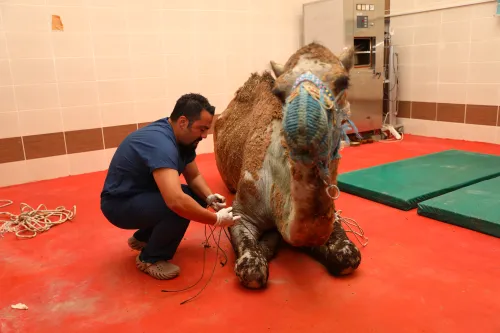
At Burdur Mehmet Akif Ersoy University (MAKÜ) Faculty of Veterinary Medicine, the stem cell treatment process has been initiated for a 7-year-old male camel diagnosed with retinal disease.
The camel, raised as a wrestling camel and brought from Aydın with a suspicion of cataract, was found to have a retinal-related issue during examinations and tests.
With the treatment conducted by Assoc. Prof. Dr. Harun Çınar from the Department of Surgical Sciences and Dr. Emine Kübra Bilir from the Department of Pathology, the aim is to restore the camel's eye health.
Retinal functions evaluated with electroretinography
The camel, which has been under observation at MAKÜ Faculty of Veterinary Medicine for about a week, underwent general health and eye examinations. Imaging methods such as color ultrasonography and angiography were utilized for a detailed assessment of the issue in the retinal area.
At MAKÜ Faculty of Veterinary Medicine Animal Hospital, the electroretinography (ERG) method, which measures the electrical activity of the retina, was also used to evaluate retinal functions.
Assoc. Prof. Dr. Harun Çınar stated that the camel was brought in with a suspicion of cataract, and retinal disease was detected in the tests. He expressed that they decided to apply stem cell treatment to the camel together with Dr. Emine Kübra Bilir.
Cells to be obtained from the camel's own blood will be used
Dr. Emine Kübra Bilir reported that it is planned to use progenitor, or precursor cells obtained from the camel's own blood as part of the treatment.
Bilir noted that the necessary samples have been taken and the treatment process is ongoing, stating that efforts are being made for the camel to regain its health.
Bilir expressed that this is the first time a treatment study of this kind has been conducted on a camel in Turkey, stating that the process will be shaped according to the findings obtained.
The treatment process is expected to last one to two months
It was stated that the treatment process could take approximately one to two months, and this duration may vary depending on the evaluations to be made and the results obtained.
The findings obtained from the study are expected to contribute to research on the treatment of retinal diseases in camels.